
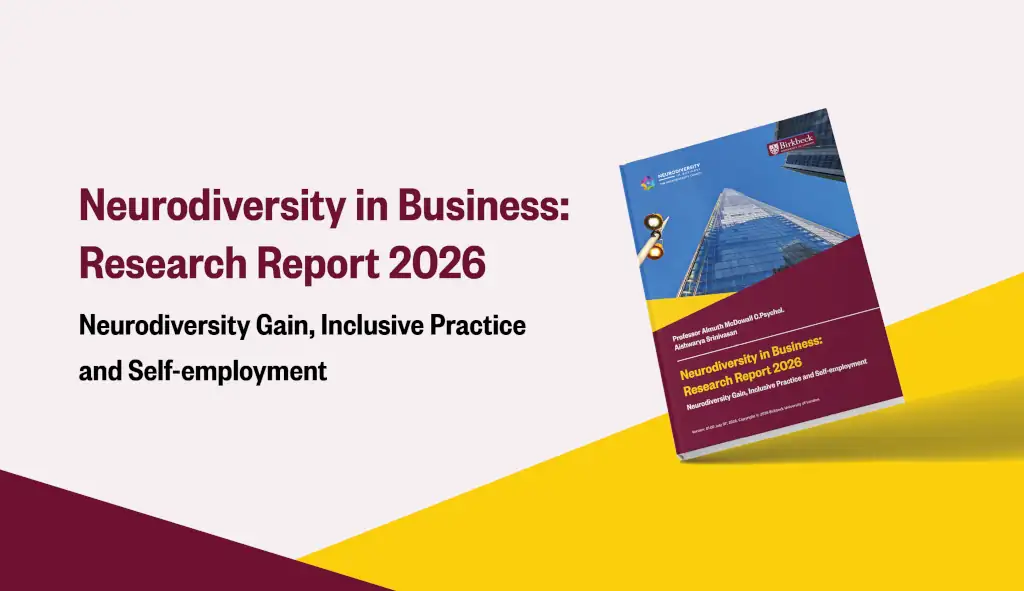
For the third year, we are proud to partner with Birkbeck, University of London, to build on our 2023 and 2024 reports. This foundational work has deepened our understanding in practice and academic communities. We extend our heartfelt thanks to sponsor: Sage whose generous support made this undertaking possible. This year, we have included the perspective of people who have opted out of corporate life. The data comparison shows us that employers are at risk of losing exceptional talent. Despite gains in line manager and colleagues support, the data documents that year on year neurodivergent employees have consistently worse work experience. It need not be that way. Our programme of research makes the business case for workplaces that truly embrace neuroinclusion by embedding wellbeing and inclusion into their core strategies, policies and process. This is more important than ever in 2026, given an increasingly volatile geopolitical context. Let’s celebrate our shared humanity and the power of different human minds.
— Dan Harris
Key findings
- Neurodivergent people bring valued strengths including critical, sharp and disruptive thinking.
- Psychological safety remains a major issue. Peer-reviewed analysis of 2023 data identified it as the strongest driver of wellbeing, career satisfaction and retention. It has not improved in 2026.
- Burnout risk is high, particularly for people with multiple neurotypes. Key drivers include cognitive load, inconsistent organisational support and inflexible structures.
- Return to office mandates have a negative impact.
- 38% of neurodivergent employees had received a mandate, and more than half of these said it made them reconsider staying with their employer.
- The data shows that return to office mandates reduce employee engagement, diminish career satisfaction and increase burnout.
- Neurodivergent entrepreneurs value autonomy, purpose and flexibility. Nearly half identified their neurodivergence before leaving corporate roles. 61% said they would not return to corporate employment.
- Many thrive when they can design their own neuroaffirming working environment.
- They also reported unpredictable workloads, administrative pressure, financial strain and the challenge of managing capacity without organisational support.
- Employers want to improve neuroinclusion, but face practical barriers. These include limited disclosure, constrained budgets, unclear processes and persistent myths that adjustments do not make a meaningful difference.
- Line managers are central to sustainable inclusion. They need specialist support, clear processes and the confidence to respond effectively to individual needs.
Neurodiversity gain
The report introduces the concept of neurodiversity gain. This is the idea that when organisations redesign systems, processes and cultures to work for neurodivergent people, everyone benefits. The authors argue that neuroinclusion is not an act of benevolence but a strategic lever for competitive advantage, workforce sustainability and organisational performance.
“Neurodivergent talent is central to the UK’s capacity to tackle its economic inactivity crisis. If we can get work right for this diverse group, everyone benefits. We call this neurodiversity gain. Flexible and adaptive approaches are key to harness specialist talent.”
— Almuth McDowall
Recommendations
- Embed neuroinclusion within corporate strategy.
- Reconsider blanket return-to-office mandates.
- Give line managers specialist training and support.
- Centralise and simplify workplace-adjustment processes.
- Learn from the autonomy, flexibility and neuroaffirming practices developed by neurodivergent entrepreneurs.